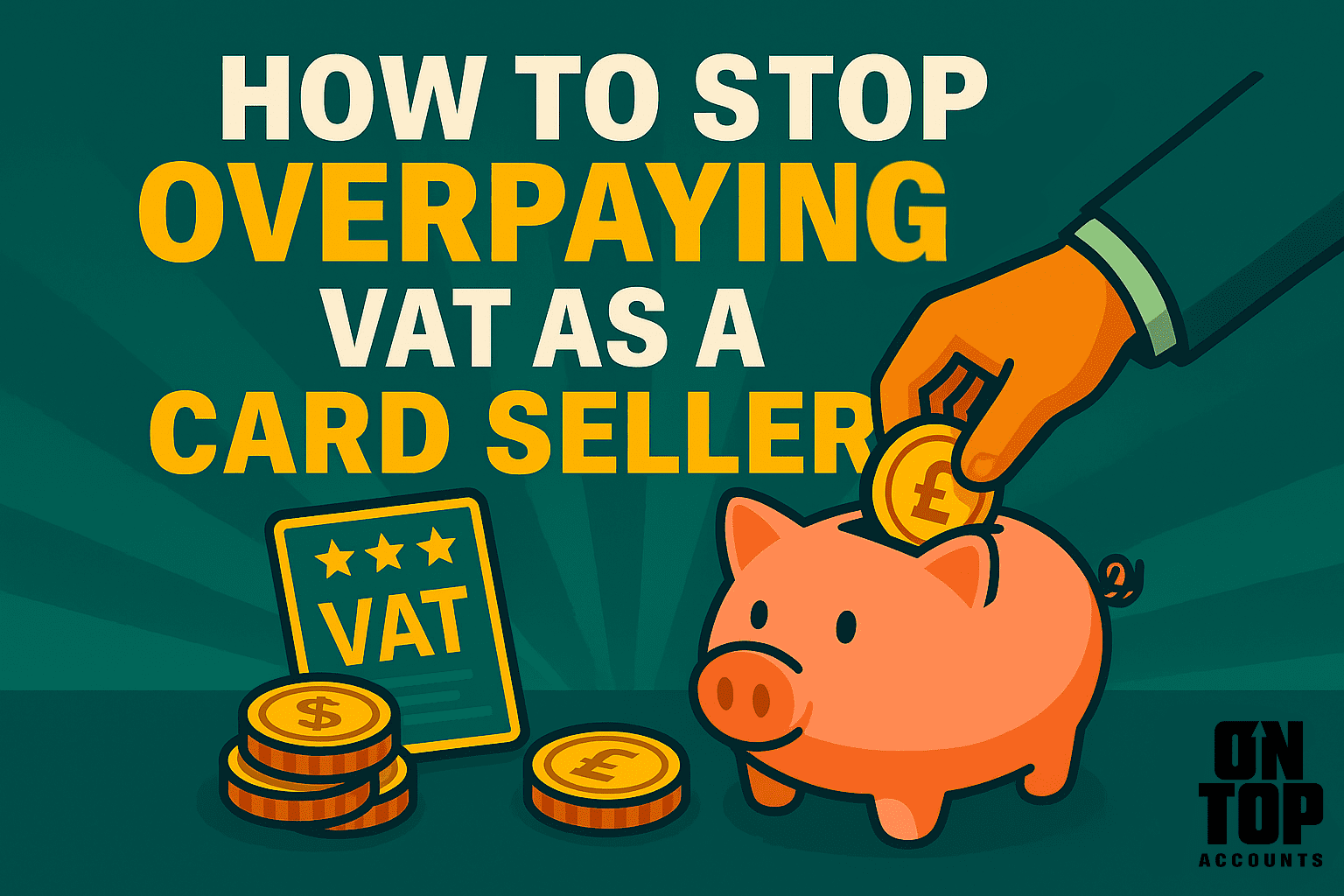
How to Stop Overpaying VAT as a Card Seller
The VAT Margin Scheme for card sellers — done properly
Most VAT-registered card sellers pay more VAT than the rules require. Not because they’re careless — because the scheme that fixes it comes with record-keeping demands that spreadsheets weren’t built for, and almost nobody explains it in card-business terms. This is that explanation.
Guidance, not advice: your VAT treatment depends on your circumstances and is a decision for you and your accountant. Everything below is general education based on HMRC’s published rules.
What the margin scheme actually is
Normally, a VAT-registered business accounts for VAT on the full selling price. The VAT margin scheme works differently for second-hand goods: you pay VAT only on your margin — the difference between what you paid for an item and what you sold it for — at one-sixth (16.67%) of that margin.
A general, illustrative example with round numbers. You buy a card from a private collector for £60 and sell it for £90:
- Under the margin scheme: margin = £30, VAT due = £5.
- Under normal VAT rules: VAT due = £15 (one-sixth of the £90 selling price) — and there was no VAT invoice on the purchase, so there’s nothing to reclaim against it.
Same card, same sale — £10 difference. Multiply that across a year of singles sales and the scheme is often the difference between a card business that works and one that doesn’t.
Why it fits card businesses — and where it doesn’t
The scheme covers eligible second-hand goods and collectors’ items bought without a VAT invoice — typically from private individuals. That’s most singles: collection buys, trade-ins over the counter, cards from non-registered sellers.
It does not cover stock you bought on a VAT invoice — your new sealed product from a distributor is standard-rated in the normal way (and you reclaim the input VAT on it as usual). So a real card business usually runs both regimes at once: sealed under normal rules, second-hand singles under the margin scheme. That split is where record-keeping starts to matter.
Two more rules that catch sellers out: you cannot reclaim VAT on margin-scheme purchases, and if you can’t evidence what you paid for an item, you can’t use the scheme for it at all — that sale defaults to VAT on the full selling price. The £300 collection bought for cash with no record isn’t just untidy bookkeeping; it’s a real VAT cost.
The record-keeping that makes it work
HMRC’s Notice 718 requires a stock book for margin-scheme goods: for each item, a unique stock number, purchase date and price, who you bought it from, description, sale date and price, the margin, and the VAT due. Item by item.
For a shop moving hundreds of singles a week, that requirement is exactly why “we’ll sort the VAT at quarter-end” doesn’t survive contact with reality. The information the stock book needs exists at two moments — when the card comes in and when it goes out — and if it isn’t captured then, it usually isn’t captured at all.
There is a bulk variant, Global Accounting, designed for high-volume, low-value stock: VAT is worked out on the margin between total eligible purchases and total sales in a period, rather than item by item. Items you paid more than £500 for are excluded — those must be accounted for individually. Whether Global Accounting suits your mix of bulk singles and higher-value cards is precisely the kind of election your accountant should make deliberately, not something a system should assume.
The mistakes that cost real money
The patterns that come up again and again with card businesses: applying the scheme to sealed product bought on VAT invoices; buying collections with no purchase evidence and losing scheme eligibility for the lot; mixing margin and standard-rated sales in one undifferentiated till; and quietly crossing the £90,000 registration threshold because nobody was tracking rolling twelve-month turnover.
None of these are exotic. All of them are expensive. And all of them are prevented at the moment of purchase or sale — not discoverable at the return.
What this means in practice
The margin scheme rewards businesses that can answer one question for every second-hand card they sell: what did this exact item cost, and can you prove it? If your records can answer that automatically — because purchase price and evidence were captured when the card came through the door, and the sale matched back to that item at the till — the scheme is straightforward and the savings are real. If they can’t, the scheme is a risk rather than a benefit.
That’s the problem OTA is built around: each card’s cost and evidence captured once at intake, the margin worked out per item, anything unclassified held visibly for a decision instead of guessed, and the record your accountant needs produced from the normal act of buying and selling — while the treatment decisions themselves stay exactly where they belong, with you and your accountant.
If your card business is VAT-registered — or your turnover is heading toward the threshold — this is worth getting right before the volume grows. Book a free 30-minute discovery call and we’ll tell you honestly whether OTA is the right fit.
Rates and thresholds referenced are as published on GOV.UK at the time of writing (August 2026). VAT registration threshold: £90,000. Always check current figures at gov.uk.