Fee’s, Fees & Fee… What are they actually buying you?
Ask three card sellers what their platform actually charges them and you’ll usually get three confident answers — all of them the headline commission, none of them the real number. The payment fee, the fixed per-order charges, the regulatory line, VAT on the lot: they’re all quietly stacked on top, and together they decide what a sale actually pays you.
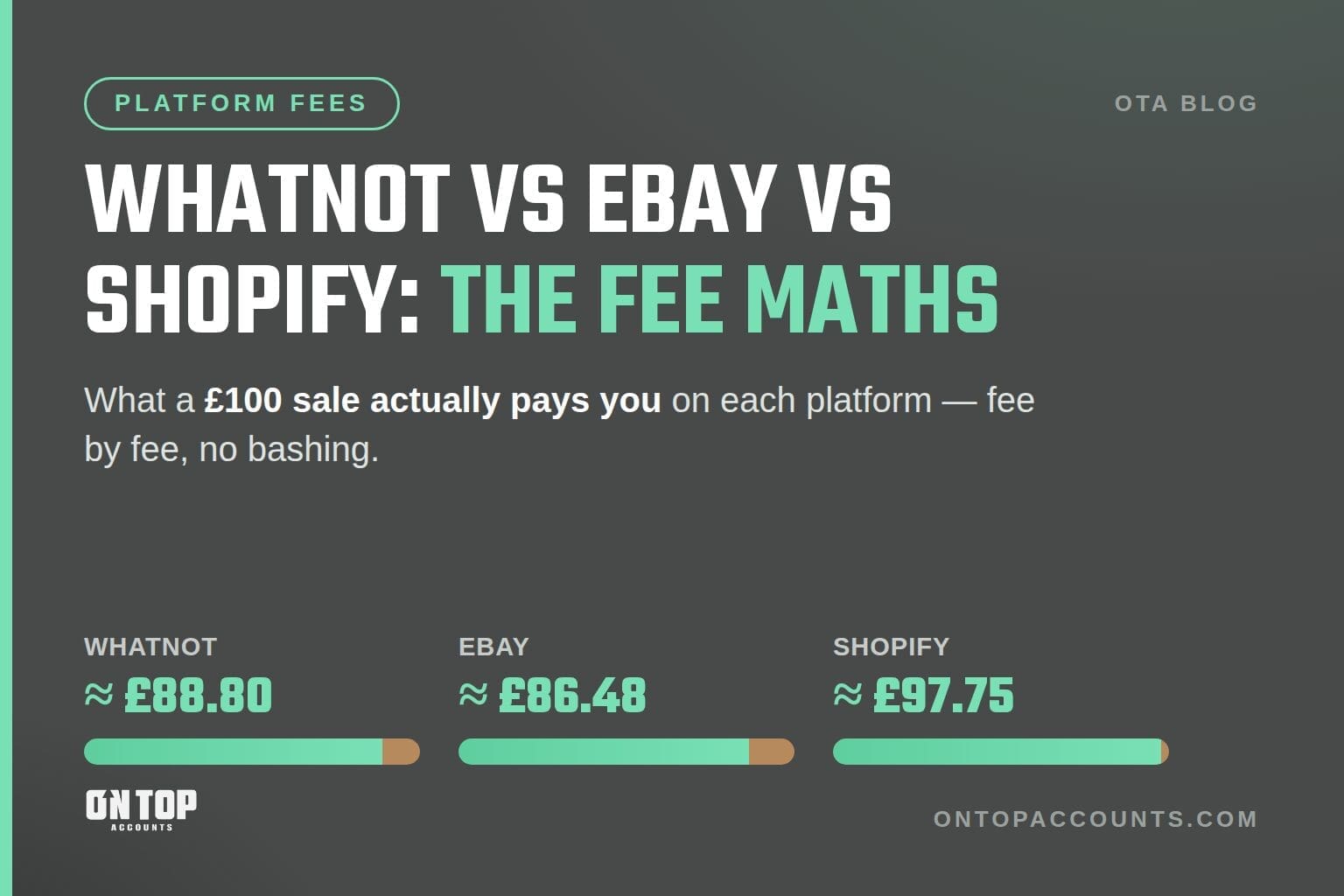
This is the follow-up to the real profit problem — fees are the first of the five profit leaks, and the easiest one to measure precisely. So let’s do the maths properly: what a £100 card sale nets you on Whatnot, eBay and Shopify in the UK, fee by fee, with no platform bashing. Just the numbers.
A dating warning before the tables: these are the published UK rates as of July 2026. Platforms revise fees and run promotions constantly — Whatnot, for instance, currently has limited-time reduced rates on lower-cost UK orders and some TCG sales. Check the official schedule on the day you price; treat this post as the method, not gospel.
Why it matters
Because the gap between the headline rate and the all-in rate is where restock decisions go wrong. A seller who believes “Whatnot takes 8%” or “eBay takes 12.8%” prices with a number several points below what actually leaves the payout. On thin card margins, a 3–4 point error in your assumed fee rate can be the whole profit.
And the fixed fees bite hardest exactly where card sellers live: low-price, high-volume. Thirty pence is nothing on a £100 slab and 6% of a £5 raw card. If your business is £3–£10 breaks and singles, the fixed pence per order matter more than the percentages.
The common mistakes
- Comparing headline commission only. Commission is one line of three or four. The payment processing fee alone adds roughly 3% on Whatnot.
- Forgetting VAT on fees. Whatnot publishes UK rates and adds VAT to its fees; eBay’s business rates generally have VAT added on top too. If you’re not VAT-registered, that VAT is a real cost you can’t reclaim. If you are, it’s cash-flow, not cost. Two sellers on the same platform can have genuinely different all-in rates for this reason alone.
- Ignoring what the fee buys. Marketplace fees are partly an audience purchase. Shopify’s fees are far lower — because nobody is browsing Shopify. You bring the traffic, and traffic isn’t free. Cheapest is not automatically best.
- Never checking the statement. The published schedule is the theory. Your monthly statement — with promos, ads, boosts, international surcharges and refunds — is the fact. The all-in rate you should price with comes from the statement.
A better approach: the £100 sale, let’s identify each fee
The worked figures below are illustrative — a £100 item, domestic UK sale, buyer-paid postage excluded for comparability, standard published rates, no promos or ads.
Whatnot (rates include VAT as Whatnot applies it):
| Sale price | £100.00 |
| Commission — 6.67% + VAT (= 8.0%) | −£8.00 |
| Payment processing — 2.42% + 25p, + VAT (≈ £3.20) | −£3.20 |
| Net payout | ≈ £88.80 |
All-in: ~11.2%.
eBay (business seller):
| Sale price | £100.00 |
| Final value fee — 12.8% | −£12.80 |
| Regulatory operating fee — 0.42% | −£0.42 |
| Fixed order fee | −£0.30 |
| Net before VAT on fees | ≈ £86.48 |
All-in: ~13.5% before VAT on fees — if VAT applies to your fees and you can’t reclaim it, nearer ~16.2% (≈ £83.78 net). Note eBay calculates FVF on the total including postage, so buyer-paid shipping nudges the real rate higher. Private sellers are a different regime entirely (eBay’s UK model now charges buyers, not private sellers) — these figures are for businesses.
Shopify (Basic plan, Shopify Payments):
| Sale price | £100.00 |
| Card processing — 2.0% + 25p | −£2.25 |
| Net payout | ≈ £97.75 |
All-in: ~2.3% — plus the £19–£25/month subscription (about 50p per order at 50 orders a month), apps, and crucially your own marketing. Shopify sells you rails, not customers. For a seller with an audience, that’s the point; for a seller without one, the “cheap” platform can be the most expensive customer-acquisition exercise in the business.
Three platforms, three totally different deals: Whatnot charges a mid-rate for a live audience and entertainment-led demand; eBay charges the highest all-in rate for the largest search-driven marketplace; Shopify charges almost nothing for infrastructure and leaves demand generation to you. None of these is wrong. Pricing as if your all-in rate were the headline rate is wrong.
The method to keep: all-in fee rate = everything the platform deducted last month ÷ gross sales, per platform, from your actual statements. That single number — not the advertised commission — is what belongs in your pricing and your cost basis and margin maths.
The OTA perspective
We’re building On Top Accounts for multi-platform card businesses, and fee fog is one of the first things it’s designed to burn off. Every Whatnot, eBay and Shopify sale is recorded gross, with the platform’s fees, refunds and postage captured against it from your own exports and statements — so your all-in rate per platform is a number you check each month, not an annual surprise. OTA is live with early card businesses; this comparison is exactly the kind of question it exists to answer from your data rather than a blog’s illustration.
Action steps
- Pull last month’s statement from each platform and divide total deductions by gross sales. That’s your real all-in rate — compare it to what you’d have guessed.
- Check the VAT treatment of your fees. Registered and reclaiming, or not? It moves your true rate by up to a fifth of your fee bill. (More in our VAT guide for card sellers.)
- Re-run your pricing floor on low-value cards. Add the fixed pence to the percentages before you decide a £4 card is worth listing.
- Note which fees are promotional. If a reduced rate is limited-time, price for the standard rate and let the promo be upside.
- Recheck the official schedules quarterly. Rates moved this year; they’ll move again.
Know your all-in fee rate on every platform before your next restock decision — it’s the difference between choosing where to sell and guessing.