Cost Basis, DONE PROPERLY
Does this costing dilemma apply to you?
Buy a single for £40 and sell it for £60 and your accounting is easy: the card cost you £40, the profit story tells itself.
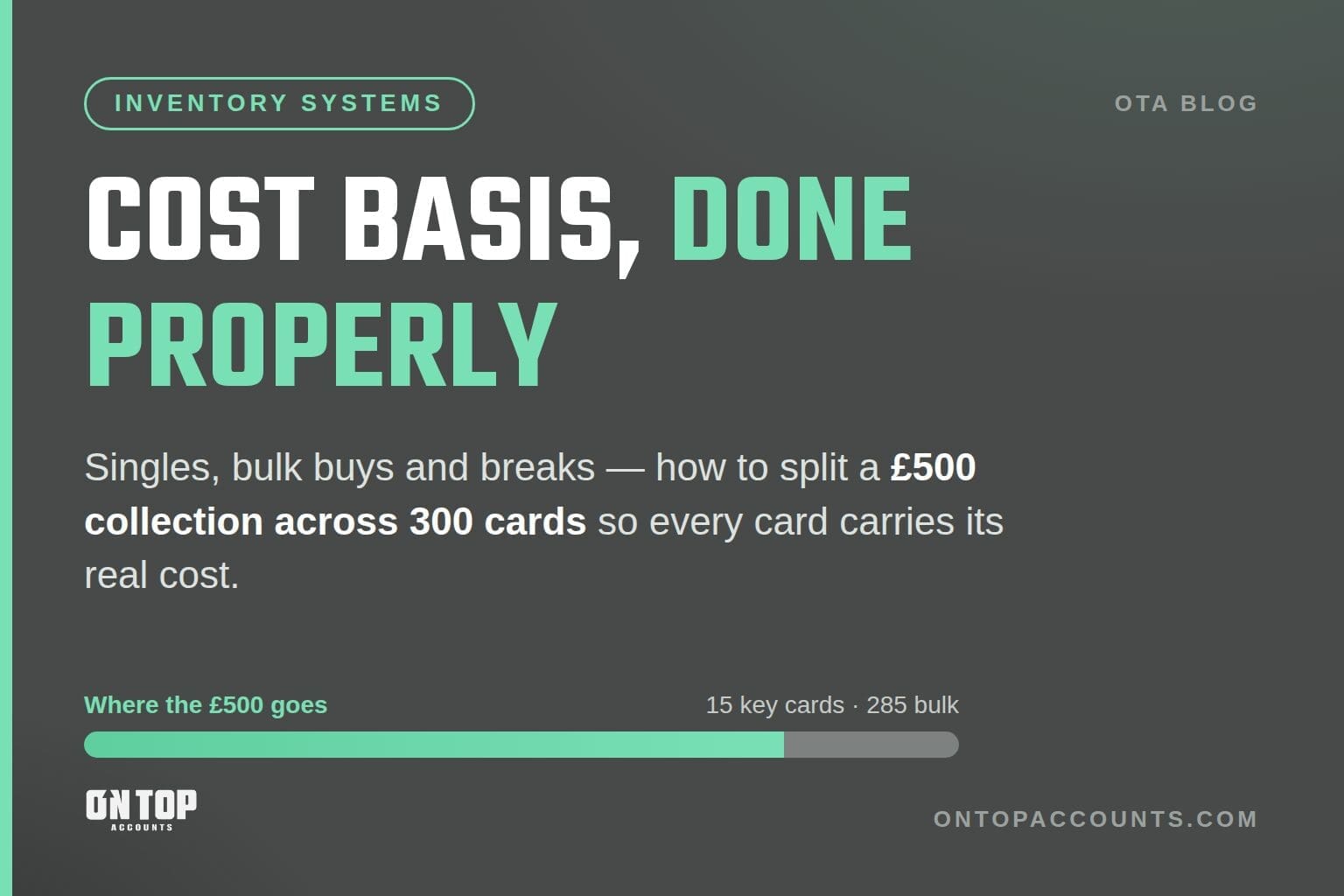
Now buy a £500 collection of 300 cards, sell the best fifteen over the next month, and answer one question: what did each of those cards cost you?
That question — cost basis — is where most card sellers’ numbers quietly fall apart. Last week we looked at the five leaks between sales and true profit; cost basis is the biggest of them, and the only one you can’t reconstruct from a platform statement. Fees and postage leave a paper trail. Cost basis is a decision, and if you never make it, your profit figure is a guess wearing a spreadsheet’s clothes.
Why it matters
Cost basis feeds every number you care about. True profit on each sale, stock value at cost and margin by product line, platform and buy. These are the figure that ends up in your Self Assessment or company accounts — which means HMRC cares about it too, even if you don’t.
Get it wrong in one direction and you overstate profit, and pay tax on money you never made. Get it wrong in the other and you understate profit — a problem that surfaces at the worst possible moment, in an enquiry, with the burden on you to show how you calculated it. A written-down, consistent method is what makes your numbers defensible. “It felt about right” is not a method.
There’s a business cost too. Sellers who don’t know what their cards cost can’t tell a good buy from a lucky one. The £500 collection that felt like a steal — was it? Without allocated cost basis, you’ll never actually know.
The common mistakes
Four patterns cover almost every cost basis mess we see:
- The tax-time reconstruction. “I’ll sort it out in January.” By January the listing is gone, the receipt is a fading memory, and you’re allocating from vibes.
- The zero-cost single. A card pulled from a box or a bulk buy gets listed with no cost attached, so its “profit” is its whole sale price. Multiply by hundreds of cards and your profit is fiction.
- The equal split that flatters the grail. £500 across 300 cards = £1.67 each — applied to a £150 card and a 10p common. Your best cards look absurdly profitable; your bulk looks like a loss-maker. Both are wrong.
- The method that changes with the weather. Weighted this month, equal split next, whatever the spreadsheet mood allows. Inconsistency is its own error: your numbers stop being comparable, and consistency is precisely what HMRC expects of a chosen basis.
A better approach: three methods, and when each applies
All figures below are illustrative, not client data. Say you buy a 300-card collection for £500. Sorting through it, you find 15 cards worth comping — call it £360 of market value between them — and 285 bulk commons worth perhaps £90 in aggregate.
Method 1
Equal per-card split. £500 ÷ 300 = £1.67 per card. Use it when the cards are genuinely similar in value: a bulk lot of commons, a job lot of unsorted base cards. It’s fast, and for uniform stock it’s fair. It falls apart the moment the lot contains anything you’d comp individually.
Method 2
Weighted by market value. Comp the meaningful cards, then allocate the £500 in proportion to value. The 15 key cards carry £360 of the £450 total market value — 80% — so they carry 80% of the cost: £400 between them, each in proportion to its own comp. The 285 bulk cards share the remaining £100 (about 35p each). Now the £150 grail carries a realistic cost, your per-card margins mean something, and a good buy shows up as a good buy. This is the default method for mixed collections.
Method 3
Salvage (bulk-first). When the bulk is genuinely junk, value it first at a nominal salvage rate — say 285 cards at 20p, £57 — and allocate the remaining £443 across the key cards, weighted by comp. Use this when the bulk will be sold as one blind lot, if it sells at all. It keeps the interesting cost information where the interesting cards are.
Breaks are the same logic wearing a different hat: the box cost is the “collection”, the pulls are the “cards”, and the allocation should be weighted by value of what’s pulled — a topic big enough that it gets its own post in a few weeks.
Whichever method fits, the rule is the same: choose it, write it down, and apply it at the moment of purchase. Cost basis recorded on the day is data; cost basis reconstructed in January is folklore. It’s also the discipline that makes inventory management work — a stock list without costs is a catalogue, not a business record.
The OTA perspective
We’re building On Top Accounts for exactly this kind of problem. Generic accounting software has no concept of one purchase becoming three hundred sellable items; it wants one price for one thing. So sellers keep the allocation in their heads or a side spreadsheet, and the books drift away from reality.
To be honest about where we are: OTA is being built now, in the open, with early card businesses. But bulk-buy allocation is core to it — record the purchase, comp the key cards, pick the method, and let the system carry the per-card cost through to every future sale, rather than doing the same arithmetic by hand every time.
Action steps
- Pick your method for mixed buys — weighted by value is the sensible default — and write it down in one sentence you can follow every time.
- Allocate your last collection purchase properly. One buy, done right, shows you the workload and the payoff.
- Attach a cost to every card currently listed with none. A defensible estimate beats a zero, and zeros are what inflate your “profit” most.
- Log the next purchase on the day. Price paid, card count, key cards comped, allocation done. Ten minutes while the parcel is still on the table.
- Keep the evidence. The listing, the invoice, the comp screenshots — whatever shows how you got the numbers, filed where January-you can find it. (If you’re VAT-registered, the same evidence discipline pays off twice — see our VAT guide for card sellers.)
None of this is glamorous. All of it is worth fixing before you scale — future you, sitting down to do the tax return, will be grateful.