Sub-Total: £0.00
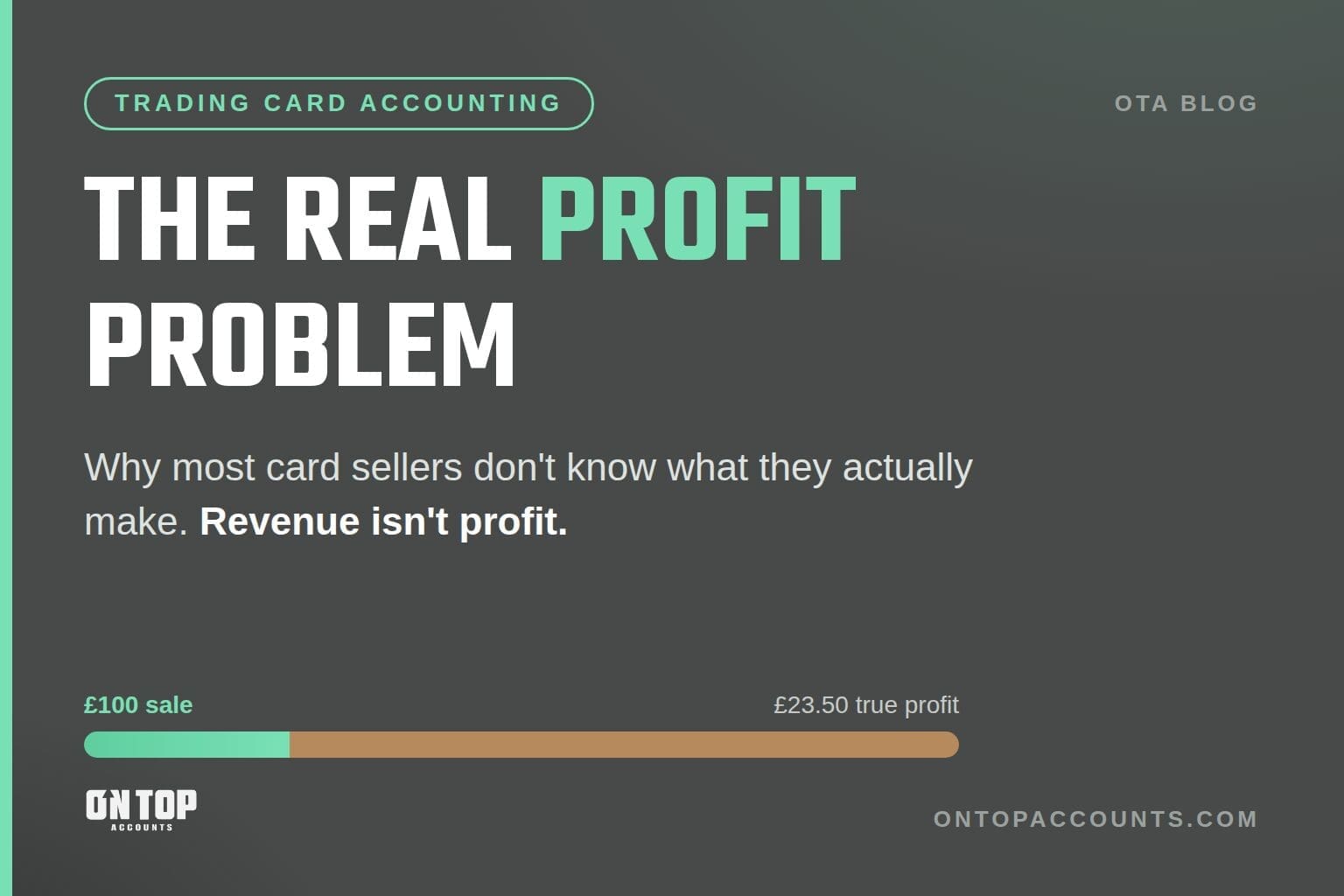
The Real Profit Problem
Ask a card seller what they turned over last month and most will tell you within a few seconds. Whatnot shows it. eBay shows it. Shopify shows it on the home screen of the app.
When asking what they actually made last month and the answer usually starts with “roughly…” and ends somewhere between a guess and a hope. That’s itself is the real profit problem.
That gap — between the sales number you know and the profit number you don’t — is the single most common financial problem in trading card businesses. Not VAT, not bookkeeping backlog, not messy spreadsheets. Those all matter, but they sit downstream of this one: most sellers are running their business on revenue, and revenue is not profit.
Why it matters
Revenue is the number that feels good. Profit is the number that pays you.
When you don’t know your true profit, every decision downstream gets made on bad information. Restocking into products that move quickly but barely clear a margin. Pricing singles off comps without knowing what it costs you to get a card out of the door. It is easy to look at a £4,000 month and feel like the business is flying, while the bank balance quietly disagrees.
It compounds at tax time, too. Sellers who don’t know their profit tend to discover it once a year, when their accountant tells them — and by then it’s history you can’t act on. If you’re weighing up decisions like sole trader vs limited company, the profit number is the starting point for all of them.
And the most uncomfortable version: some sellers who believe they’re profitable are, after every cost is counted, working for less than minimum wage — or funding the hobby from the day job without realising it. You can’t fix that if you can’t see it.
The common mistake: counting one cost, ignoring four
Almost nobody ignores costs entirely. The common mistake is counting the obvious cost — what you paid for the card — and treating everything else as noise.
In a card business, the noise is where the margin goes. There are five leaks between your sale price and your true profit:
- Platform and payment fees. Selling fees, payment processing, ads or boosts. Individually small percentages; together, often 10–15% of every sale before anything else.
- Postage and packaging. The label you paid for, and the gap between what you charged for shipping and what it actually cost — a gap that’s negative more often than sellers think.
- Cost basis. What the card genuinely cost you. Easy for a single you bought outright; much harder for a card pulled from a box, bought in a bulk lot, or left over from a break. Most sellers’ cost basis is a guess, which means their profit is a guess. (This is also why inventory management makes or breaks sellers — cost tracking and inventory tracking are the same discipline.)
- Supplies. Sleeves, top loaders, team bags, boxes, tape, thermal labels. Pennies per order, hundreds of pounds per year.
- Overheads. Software subscriptions, storage, insurance, that grading-submission service fee. Costs that exist whether or not you sell anything, and therefore get left out of every per-sale calculation.
Miss one leak and your profit is flattering. Miss three and it’s fiction.
A better approach: work one sale all the way through
Here’s the exercise that changes how sellers see their business. Take one real sale and follow every pound. The numbers below are illustrative, not client data — run your own through the same steps.
Say you sell a slab for £100 on a marketplace:
| Sale price | £100.00 |
| Platform + payment fees (13% all-in, illustrative) | −£13.00 |
| Postage and packaging | −£4.50 |
| Supplies (sleeve, top loader, mailer, label) | −£1.00 |
| Cost basis (allocated from the £250 lot it came in) | −£55.00 |
| Share of monthly overheads (software, storage) | −£3.00 |
| True profit | £23.50 |
The seller who only counts the card cost thinks they made £45. The real number is barely half that. Nothing went wrong in this sale — no refund, no damaged card, no fee surprise. This is what a good sale looks like once every cost is counted.
That gives you the formula worth pinning above your desk:
True profit = sale price − fees − postage & packaging − supplies − cost basis − a fair share of overheads
None of the maths is hard. What’s hard is doing it consistently across hundreds of sales, on multiple platforms, with cost basis spread across lots, boxes and breaks. That’s a systems problem, not an intelligence problem.
The OTA perspective
We’re building On Top Accounts specifically for trading card businesses, and this problem — true profit — is the reason it exists. Generic accounting software has no concept of a card pulled from a break, a bulk lot split across fifty listings, or a comp moving 30% in a week. So sellers end up with tidy books that still can’t answer the only question that matters: what did I actually make?
Honest disclosure: OTA is being built right now, working openly with early card businesses; it isn’t a finished product with hundreds of clients. But everything in it starts from the calculation above — fees, postage, supplies, cost basis and overheads captured against every sale, so true profit is a number you check, not an exercise you dread.
Action steps
- Run one sale through the formula this week. One card, every cost. The gap between felt profit and true profit tells you how big your problem is.
- Work out your all-in fee rate. Last month’s total fees ÷ total sales, per platform. Most sellers who do this for the first time are surprised.
- Write down a cost basis rule for lots and breaks. Even a rough allocation applied consistently beats a precise number you only calculate sometimes.
- List your monthly overheads once. Total them, divide by your typical monthly sales count, and you have a per-sale overhead figure to reuse.
- Check the tax side while you’re in there. If you’re VAT-registered or close to the threshold, profit errors and VAT errors usually travel together — see our guide to stopping VAT overpayment as a card seller.
If your card business has outgrown guesswork, this is exactly the problem OTA is being built to solve. Read the worked breakdown above with your own numbers, and if the gap alarms you — that’s the signal.